Introduction and Principles of reproducibility
Introduction
Programme Overview
What this training is and is not
It is
- ✅ An introduction to R for those without previous experience
- ✅ About using RStudio Projects and good practice for code
- ✅ An introduction to the tidyverse
It is not
- ❌ An introduction to statistics
- ❌ Magic
Learning Objectives
After this workshop the successful learner will be able to:
- Explain the rationale for scripting analysis
- Find their way around the RStudio windows
- Create and plot data using ggplot
- Know how to load packages
- Understand what is meant by the working directory, absolute and relative paths and be able to apply these concepts to data import
- Summarise data in a single group or in multiple groups
Principles of reproducibility
What is reproducibility?
Research reproducibility is central to the scientific method. It is achieved in a variety of ways.
In this context I mean “computational reproducibility” (National Academies of Sciences et al. 2019):
Reproducible: Same data + same analysis = identical results
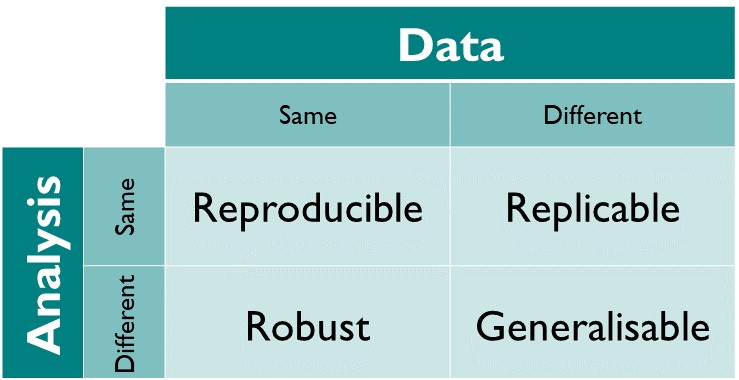
Replicable: Different data + same analysis = qualitatively similar results. The work is not dependent on the specificities of the data.
Robust: Same data + different analysis = qualitatively similar or identical results. The work is not dependent on the specificities of the analysis.
Generalisable: Different data + different analysis = qualitatively similar results and same conclusions.
Why does reproducibility matter?
Many high profile cases of work which did not reproduce e.g. Anil Potti unravelled by Baggerly and Coombes (2009)
Five selfish reasons to work reproducibly (Markowetz 2015). Alternatively, see the very entertaining talk
Will become standard in Science and publishing e.g OECD Global Science Forum Building digital workforce capacity and skills for data-intensive science (OECD Global Science Forum 2020)
How to achieve reproducibility
Reproducibility is a continuum. Some is better than none!
Script everything
Organisation: Project-oriented workflows with file and folder structure, naming things
Code: follow a consistent style, organise into sections and scripts (be modular), Code algorithmically
Documentation: Readme files, code comments, metadata,
More advanced: version, control, continuous integration and testing
Further reading
- Data Organization in Spreadsheets (Broman and Woo 2018)
- Ten simple rules for reproducible computational research (Sandve et al. 2013)
- Best practices for scientific computing (Wilson et al. 2014)
- Good enough practices in scientific computing (Wilson et al. 2017)
- Excuse Me, Do You Have a Moment to Talk About Version Control? (Bryan 2018)
Pages made with R (R Core Team 2026), Quarto (Allaire et al. 2026), knitr (Xie 2025, 2015, 2014), kableExtra (Zhu 2024)